


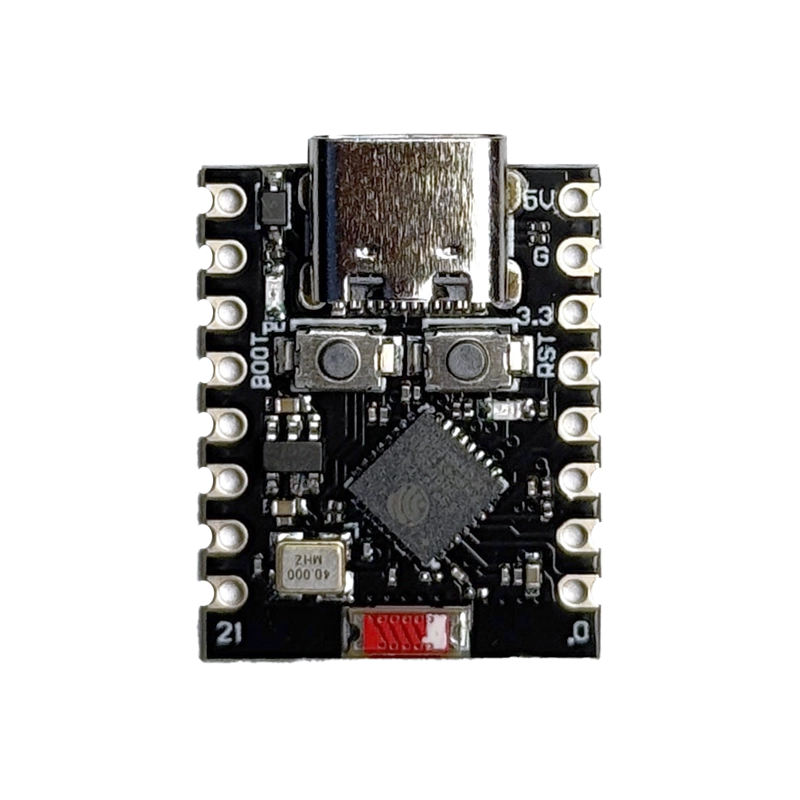
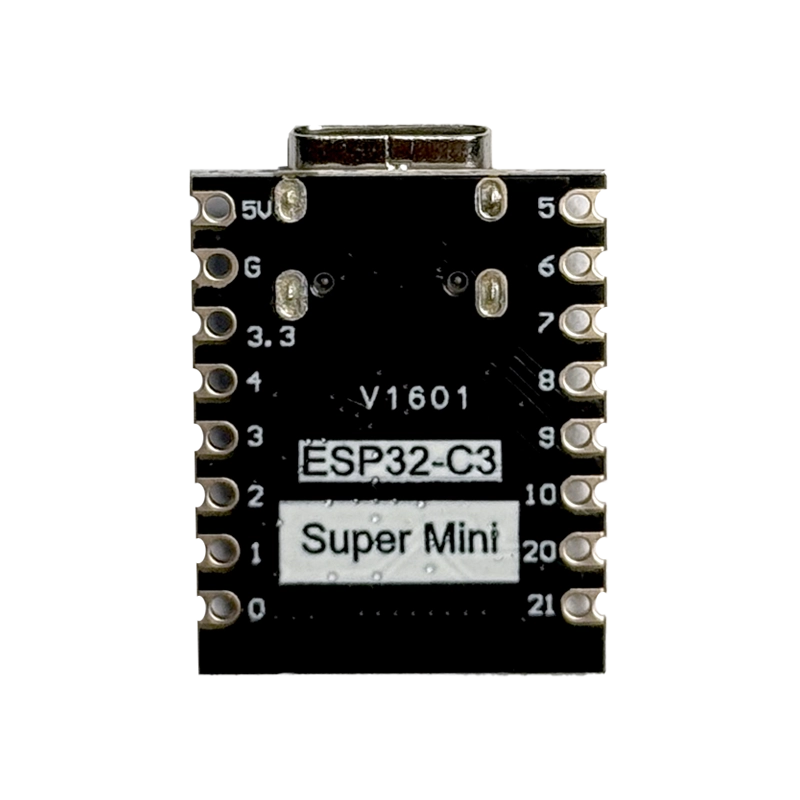
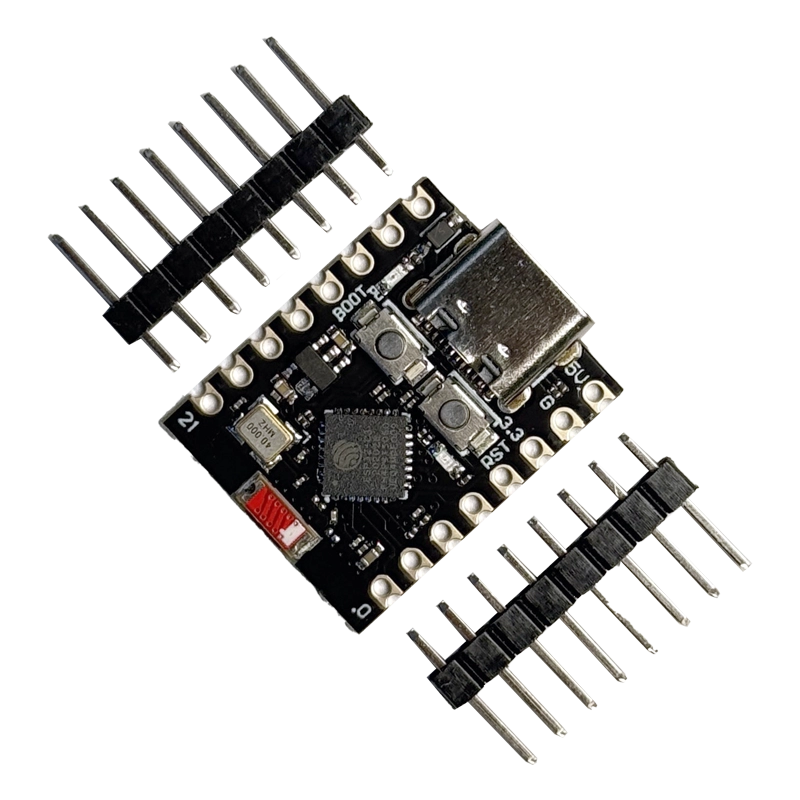


ESP32 C3 Super Mini Development Board packs a full RISC-V powered Wi-Fi and Bluetooth system into one of the smallest footprints available to Indian makers today. If you have been hunting for a board that fits inside tight enclosures without giving up wireless performance, this ultra-compact module from Techiesms is built exactly for that job — rapid prototyping, wearable builds, and always-on IoT nodes that need to disappear into the design, offered at the best price in India.
Technical Specifications
Every spec of the ESP32 C3 Super Mini Development Board below has been verified against Espressif’s official ESP32-C3 datasheet, so you can design around it with confidence.
| Parameter | Value |
|---|---|
| Microcontroller | ESP32-C3, 32-bit RISC-V single-core |
| Clock Speed | Up to 160 MHz |
| Wi-Fi | IEEE 802.11 b/g/n, 2.4 GHz |
| Bluetooth | BLE 5.0 |
| Flash Memory | 4 MB |
| SRAM | 400 KB |
| Operating Voltage | 3.3 V |
| Input Voltage | 3.3 V–5 V via USB Type-C |
| GPIO | 11 programmable pins (PWM, ADC, UART, SPI, I2C) |
| Analog Inputs | Up to 6 ADC channels |
| USB Interface | Type-C (integrated USB-to-serial) |
| Dimensions | Approx. 22.5 mm x 18 mm |
| Operating Temperature | -40°C to +85°C |
| Power Consumption | Deep sleep approx. 43 µA |
| Onboard LED | User programmable, GPIO8 |
| Headers | Included, not pre-soldered |
What Makes It Stand Out
Most beginner boards force a choice between size and capability. The ESP32 C3 Super Mini Development Board does not — it packs a 160 MHz RISC-V core, dual-mode wireless radio, and a full USB-C interface onto a breadboard-friendly footprint barely bigger than a coin. Every parameter above is cross-checked against the official ESP32-C3 series datasheet, so there is no guesswork in your enclosure or power budget.
It runs on the same actively maintained Arduino-ESP32 core used across the ESP32 family, so existing sketches and libraries carry over with minimal changes when you switch to the ESP32 C3 Super Mini. Deep sleep current near 43 µA also means it can survive on a coin cell for battery-powered sensor nodes.
Why Makers Choose This
The ESP32 C3 Super Mini Development Board wins over larger ESP32 boards whenever space is the constraint — wearables, small remotes, hidden sensor pucks, and anything meant to sit inside a 3D-printed shell. USB Type-C means one universal cable for power, programming, and debugging.
For a structured first build, this getting-started guide walks through setup, drivers, and your first upload, so even a first-time maker is running code within minutes.
Important Links
🔗 ESP32-C3 Series Datasheet — official Espressif datasheet with full electrical and pinout specifications.
🔗 Arduino-ESP32 Core (GitHub) — official library and board support package for programming in Arduino IDE.
🔗 Getting Started Tutorial — step-by-step setup and first upload guide for beginners.
Best Used For
Makers across India use the ESP32 C3 Super Mini Development Board for compact IoT sensor nodes reporting temperature, humidity, or motion data over Wi-Fi. It also shows up in wearable prototypes and fitness-tracker experiments, where every millimetre of PCB space matters. Home automation tinkerers rely on it for small BLE or Wi-Fi relay modules behind switchboards, robotics students use it as a lightweight wireless brain for small bots, and its low deep-sleep draw suits battery sensors that run for months on one charge.
Frequently Asked Questions
Q: Does the ESP32 C3 Super Mini Development Board come with headers soldered? No — headers are included but not soldered, so you can solder them at your preferred angle or skip them for a direct-wire build.
Q: Can I program this board using Arduino IDE? Yes, it is fully compatible with Arduino IDE, PlatformIO, ESP-IDF, and MicroPython.
Q: How many usable GPIO pins does the ESP32 C3 Super Mini have? It breaks out 11 programmable GPIOs supporting PWM, ADC, UART, SPI, and I2C.
Q: Is the ESP32 C3 Super Mini good for battery-powered projects? Yes — deep sleep current is around 43 µA per the official datasheet, well suited to coin-cell or small LiPo nodes.
Q: Are programming issues covered under return or replacement? No, firmware and coding issues are not covered — please troubleshoot on your end, using the linked getting-started guide if needed.
Related Products
ESP32 Dev Movdule
XIAO ESP32 C3 Development Board




Reviews
Clear filtersThere are no reviews yet.