



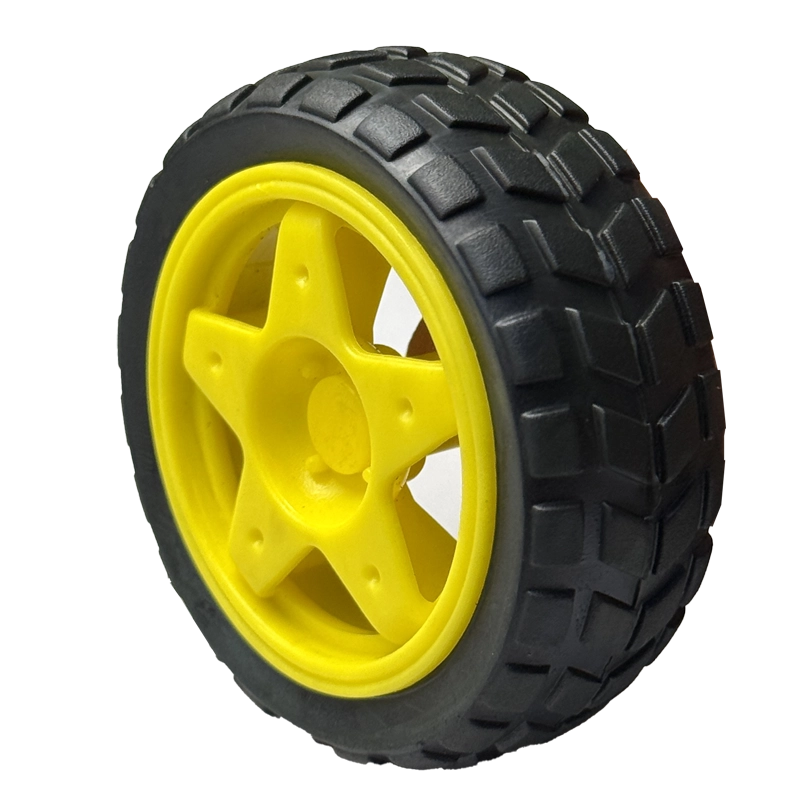
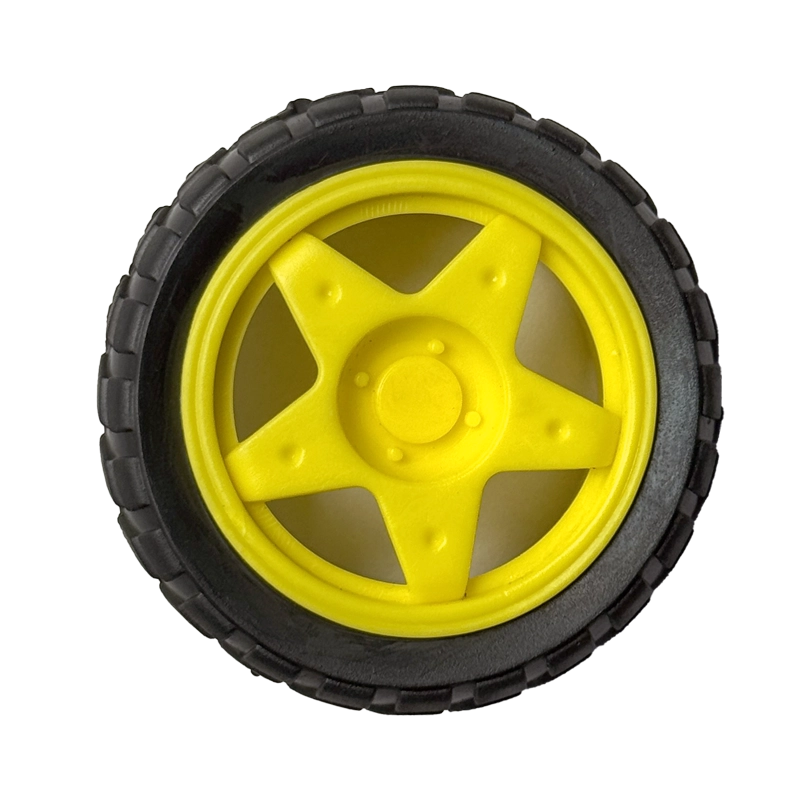
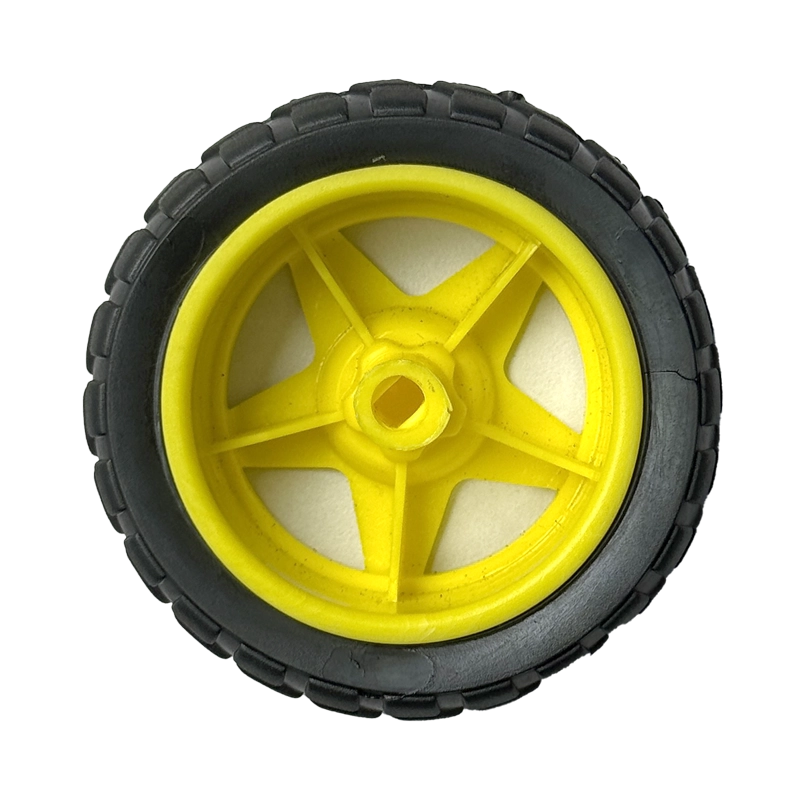
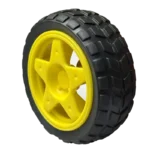
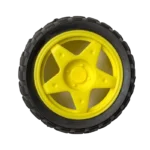
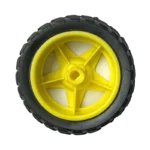


BO motor wheel choice decides how well your robot grips the floor, and this 65mm rubber wheel gets it right. A soft, treaded rubber tyre sits on a nylon-reinforced plastic rim that press-fits straight onto the D-shaft of a standard BO motor, with no screws, adapters or glue needed. From a first line follower to a four-wheel smart car, it is the wheel makers across India reach for first.
Technical Specifications
Verified specifications of this BO motor wheel, checked against the standard BO gear motor shaft profile:
| Parameter | Value |
|---|---|
| Wheel Diameter | 65 mm (approx.) |
| Wheel Width | 26–27 mm |
| Shaft Hole | D-type, 5.4 mm (round side) × 3.5 mm (flat side) |
| Mounting | Press-fit onto BO motor D-shaft |
| Tyre Material | Treaded rubber |
| Rim Material | Nylon-reinforced plastic |
| Colour | Yellow rim, black tyre |
| Load Capacity | Up to 2 kg per wheel (typical) |
| Weight | Approx. 39 g |
| Package Includes | 1 × 65mm Rubber Wheel |
What Makes It Stand Out
The upgraded tread is the real difference. Hard plastic wheels skid on tiles and lab floors, but this BO motor wheel bites into the surface, so your robot starts, stops and turns exactly where your code says, which matters for line followers and encoder-based distance control.
The D-shaped hub matches the standard BO gear motor shaft, the same 5.4 × 3.5 mm profile listed in this hub reference specification, so it locks in without wobble. The nylon-reinforced rim also survives repeated fitting while you tune your chassis.
The wheel needs no code of its own. Drive the motor through an H-bridge using this ready-made L298N Arduino library and you are moving within minutes.
Why Makers Choose This
The 65mm size is the sweet spot for hobby robotics: big enough to roll over carpet edges, yet small enough to keep a BO motor inside its comfortable torque range. It matches most 2WD and 4WD acrylic chassis, so spares always fit.
Students love it because it works on the first try. Pair it with this step-by-step ESP32 Wi-Fi robot car tutorial and your BO motor wheel setup becomes a phone-controlled car in an afternoon, at the best price for a classroom budget.
Important Links
🔗 D-Shaft Hub Reference Spec — the 5.4 × 3.5 mm BO/TT shaft profile this wheel fits
🔗 ESP32 + L298N Wiring Diagram — how to wire and drive BO motors with speed and direction control
🔗 ESP32 Wi-Fi Robot Car Tutorial — complete build guide for a wheeled robot car
🔗 L298N Arduino Library (GitHub) — simple motor control library for Arduino and ESP32
🔗 techiesms YouTube Channel — robotics, IoT and ESP32 project tutorials
Best Used For
This BO motor wheel is at home on line-following robots, where steady grip keeps sensor readings consistent through sharp turns. It suits obstacle-avoiding cars with an ultrasonic sensor and Bluetooth or Wi-Fi cars driven by an Arduino or ESP32. Teachers use it for science exhibition vehicles, while makers fit it to delivery-bot prototypes and 4WD rovers.
Frequently Asked Questions
Q: Will this wheel fit my BO motor?
Yes. This BO motor wheel fits standard straight and L-type BO motors, single or dual shaft, that use the common D-shaped output shaft.
Q: Do I need screws or glue to mount it?
No. The BO motor wheel press-fits directly onto the D-shaft. Push it on firmly and straight.
Q: How much weight can it carry?
Each BO motor wheel handles up to about 2 kg in typical use, plenty for hobby robots carrying a battery, sensors and a controller.
Q: Will it fit N20 or metal geared motors?
No. N20 motors and metal geared motors with round 6mm shafts need a different wheel or a suitable coupling.
Q: Can I use it outdoors?
It works on smooth paving. For grass or gravel, a larger off-road wheel is a better choice.
Related Products
Single Shaft BO Motor | 100 RPM
Dual Shaft BO Motor | 100 RPM
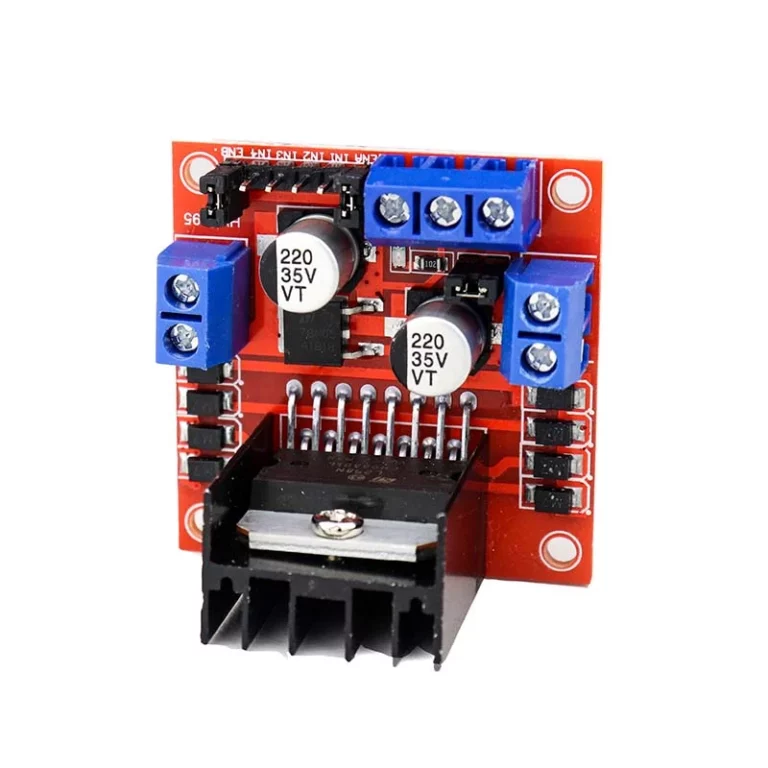
L298N Motor Driver Module
2WD Robot Kit | 2 Wheel Robot Kit
4 Wheel Smart Car Robot Chassis Kit
Castor Wheel for Robot Car



Reviews
Clear filtersThere are no reviews yet.