


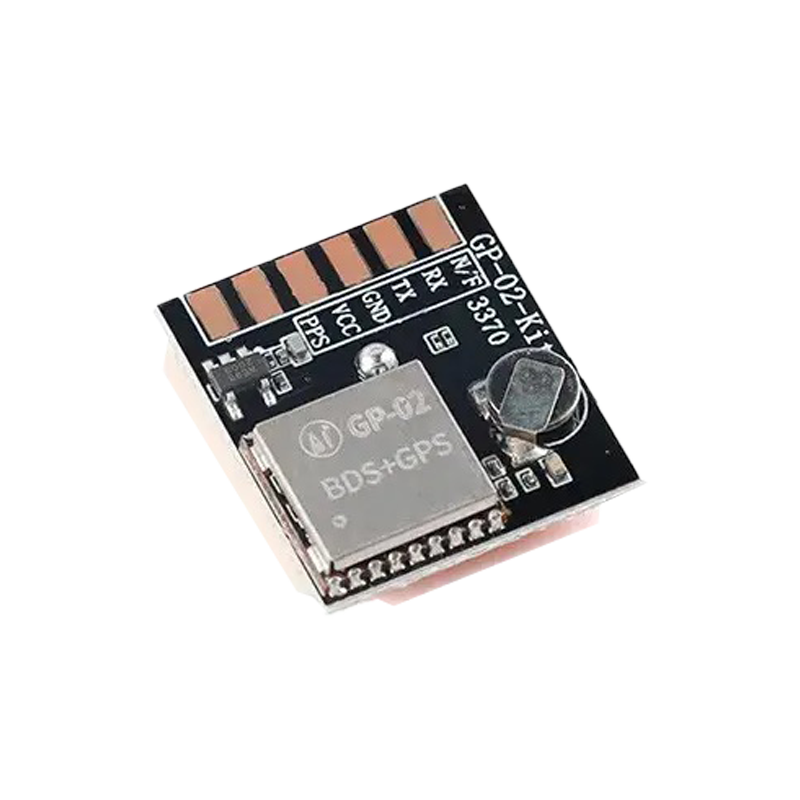



Ai-Thinker GP-02 GPS GNSS Module Kit — AT6558R Multi-Constellation Positioning Board
GPS GNSS module projects finally have a worthy foundation — the Ai-Thinker GP-02 Kit is a compact, fully integrated development board built around the AT6558R satellite positioning SoC, designed to get you accurate location fixes fast, even in difficult signal environments. Whether you are prototyping a vehicle tracker, a drone navigation system, a smart agriculture sensor node, or an IoT asset monitor, this kit gives you everything you need from the first power-up, with no external antenna hardware required.
The GP-02 Kit comes ready to use out of the box: plug in a Micro-USB cable for 5V power, connect the UART pins to your microcontroller, open a serial terminal or your NMEA parsing code, and you are receiving satellite data within seconds of powering on. It speaks the universal NMEA protocol, so it works out of the box with every major platform — Arduino, ESP32, STM32, Raspberry Pi, and more.
What Makes It Stand Out
Most basic GPS modules available in India support only single-constellation positioning — either GPS alone, or GPS + GLONASS. The GP-02 Kit’s AT6558R chip supports six satellite systems simultaneously: BDS (BeiDou), GPS, GLONASS, Galileo, QZSS, and SBAS (including WAAS, EGNOS, GAGAN, and MSAS). This multi-constellation approach means the module can see far more satellites at any given moment, giving you faster Time To First Fix (TTFF), better accuracy in urban canyons and dense environments, and more resilient positioning when one system has poor geometry.
The onboard ceramic antenna means there is nothing extra to source, mount, or cable — the entire GPS GNSS module is self-contained. An integrated active antenna detection and protection circuit monitors antenna health automatically and protects against shorts or faults, making the GP-02 Kit robust enough for field deployment and not just lab benchtop testing.
The 56-channel receiver architecture processes signals from all supported constellations simultaneously. With positioning accuracy under 2 metres (CEP), a tracking sensitivity of –162 dBm, and a data update rate of up to 10Hz, this module is tuned for applications where precision and responsiveness matter. For full technical specifications and pin assignments, refer to the official Ai-Thinker GP-02 specifications document.
Why Makers Choose This GPS GNSS Module
For makers and engineers in India, the GP-02 Kit hits a sweet spot that few GPS modules achieve: rich multi-constellation capability, an integrated antenna, and a clean UART/NMEA interface — all at a price that makes it practical to use in prototype and production alike. At ₹499, this is the best price available in India for a multi-system GNSS module with onboard antenna and development kit form factor.
The communication interface is as simple as they come: connect VCC (5V), GND, TX, and RX to your microcontroller, configure your serial port at the default baud rate, and you are reading NMEA sentences immediately. For Arduino and ESP32 projects, the TinyGPS++ library by Mikal Hart on GitHub is the standard NMEA parsing library — it extracts latitude, longitude, altitude, speed, heading, date, and time from raw NMEA data with just a few lines of code, and works perfectly with the GP-02’s output.
A comprehensive wiring and coding guide for connecting a GPS GNSS module to ESP32 with TinyGPS++ is available on Random Nerd Tutorials, with code that is directly portable to the GP-02. For a hands-on getting started walkthrough specific to this module, watch the official GP-02 Kit tutorial video which covers setup, wiring, and first fix
The industrial temperature range (–40°C to +85°C) makes this module usable in real field conditions — outdoor trackers, agricultural monitors, and vehicle-mounted systems that experience extremes of heat and cold. RoHS certification makes it suitable for commercial product development as well.
Technical Specifications
Here are the fully verified technical specifications for this GPS GNSS module:
| Parameter | Value |
| Model | GP-02-Kit |
| Main Chip | AT6558R (ZhongKe Microelectronics) |
| CPU | 32-bit RISC, up to 133 MHz (dynamic frequency scaling) |
| Satellite Systems | BDS, GPS, GLONASS, Galileo, QZSS, SBAS |
| Tracking Channels | 56 |
| Positioning Accuracy | <2 m (CEP) |
| Tracking Sensitivity | –162 dBm |
| Cold Start Sensitivity | –148 dBm |
| Update Rate | 1 Hz – 10 Hz (default 1 Hz) |
| Antenna | Integrated ceramic antenna |
| Power Input (Kit) | 5V via Micro-USB |
| Module Voltage | 3.3V (2.7V – 3.6V) |
| Interface | UART (NMEA protocol) |
| Max Baud Rate | 256,000 bps |
| Module Size | 23.4 × 12.2 × 24 mm (±0.2 mm) |
| Operating Temperature | –40°C to +85°C |
| Storage Conditions | –40°C to +125°C, <90% RH |
| Certification | RoHS |
| Features | A-GNSS, D-GNSS, PPS output, active antenna detection & protection |
Best Used For
This module excels across five real-world project categories for makers and engineers.
Vehicle and asset tracking is the most natural application for a GPS GNSS module of this capability. Mount the GP-02 Kit in a vehicle, connect it to an ESP32 with a SIM module, and you have a full live-tracking node that reports location to a cloud server or MQTT broker in real time. The multi-constellation lock means fewer dead spots on long rural routes, and the industrial temperature range handles dashboards in summer heat.
Drone and UAV navigation benefits enormously from the 10Hz update rate and sub-2m accuracy. At 10 updates per second, position data is fresh enough for flight controllers to use in stabilisation and return-to-home logic. Pair the GP-02 Kit with a flight controller over UART and configure it to output high-frequency NMEA sentences for responsive autonomous navigation.
Smart agriculture and precision farming nodes need reliable outdoor positioning across open fields and around structures that can occlude some satellite systems. With six constellations available, the AT6558R always has enough satellite diversity to maintain lock — making it ideal for field mapping robots, irrigation zone controllers, and soil sensor nodes that need to tag their readings with coordinates.
IoT location-aware devices such as smart delivery boxes, rental asset tags, and portable monitoring devices can use the GP-02 Kit as a drop-in positioning solution. The low power UART interface and 5V operation from USB make integration into ESP32-based IoT devices straightforward, and the compact size fits easily into enclosures.
Trekking and outdoor safety devices benefit from the wide operating temperature range and rugged multi-constellation support. Pair the GP-02 Kit with a display and an ESP32 to build a handheld GPS navigator, an emergency beacon transmitter, or a hike logger that records a GPX track to SD card — applications where reliable positioning under tree canopy and in valleys is essential.
Frequently Asked Questions
Q1. Does this GPS GNSS module work with Arduino and ESP32?
Yes. The GP-02 Kit communicates over standard UART using the NMEA protocol, which is universally supported across Arduino, ESP32, STM32, and any platform with a serial port. Use the TinyGPS++ library to parse latitude, longitude, altitude, speed, and time from the NMEA output with minimal code. The default baud rate is 9600 bps for most configurations.
Q2. Do I need an external antenna with this module?
No. The GP-02 Kit includes an integrated ceramic antenna onboard. You do not need to source, connect, or mount any additional antenna. The module also includes active antenna detection and protection, so it monitors antenna integrity automatically. For improved performance in heavily obstructed environments, some users add an optional active external antenna, but it is not required for typical outdoor use.
Q3. What satellite systems does this GPS GNSS module support?
The AT6558R chip supports six systems: BDS (BeiDou / China), GPS (USA), GLONASS (Russia), Galileo (EU), QZSS (Japan), and SBAS augmentation systems (WAAS, EGNOS, GAGAN, MSAS). It can position using any single system independently or in any combination of systems simultaneously for maximum accuracy and availability.
Q4. What baud rate should I use to communicate with the GP-02 Kit?
The default baud rate is 9600 bps, which is standard for NMEA GPS modules. The module supports rates up to 256,000 bps if you need faster data throughput — for example when running at 10Hz update rate with multiple NMEA sentences enabled. Most Arduino and ESP32 projects work perfectly at 9600 bps for 1Hz updates.
Q5. What is the difference between the GP-02 module and the GP-02 Kit?
The GP-02 is the bare SMD module (10.3 × 9.9 mm) designed for PCB integration into custom products. The GP-02 Kit is the development board version — it mounts the GP-02 module along with pin headers, a Micro-USB power input, and supporting circuitry, making it ready to use with jumper wires and a breadboard without any soldering. The GP-02 Kit is what you receive with this listing.
Related Products
What’s in the Box
- 1 × Ai-Thinker GP-02 Kit — a complete GPS GNSS module development board




Reviews
Clear filtersThere are no reviews yet.